TROS YOLO
Application Scenarios
RDK Studio helps developers with zero experience quickly get started and enables an efficient object detection workflow: The YOLO series, as representative algorithms in single-stage object detection, offers the advantages of fast speed and good generalization. They can achieve functions such as garbage recognition and vehicle detection, primarily applied in fields like autonomous driving and smart homes.
Preparations
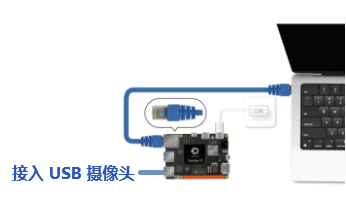
Supports connection of USB and MIPI cameras. This section uses a USB camera as an example for explanation. The USB camera connection method is as follows:
Running Process
-
Click Node-RED under the
TROS YOLOexample.
-
Enter the example application flow interface.
TipClick the
 icon in the top right corner of RDK Studio to quickly open the example in a browser!
-
Select the type of connected camera, click the corresponding
Start(USB Cam)command, and wait about 10s for the visualization window to open automatically.
-
Performance Result: Click the debug icon on the right to position the right sidebar to the debug window. You can view the performance information output results in the debug window.
-
Output Statistics: Can output statistical results of the detected types collected.
-
Click to execute the
Stopcommand to turn off the camera. Note
NoteIf modifications are made to nodes, flows, etc., you need to click the
 button in the upper right corner for them to take effect!
 -
Click the
×icon in the upper right corner,Select "Close APP" to exit the Node-RED application.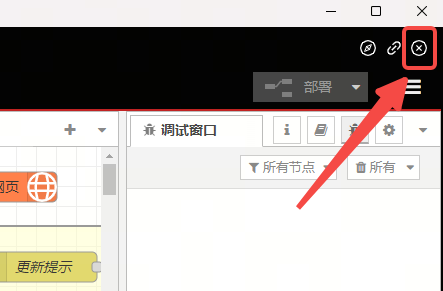
More Features
Visualization Page
-
Click to execute the
Visualization Interfacecommand to automatically open TogetherROS Web Display.
-
Click
Web Displayto enter the visualization page for real-time object detection.
-
Click the
×in the upper right corner of the visualization page to exit it.
Learn More
Click to execute the Learn More command to open the online documentation to find more information about the examples.
