USB Camera Usage
Video: https://www.bilibili.com/video/BV1rm4y1E73q/?p=18
The usb_camera_fcos.py program is installed on the development board to test the data path of the USB camera. This example captures image data from the USB camera in real-time, runs the object detection algorithm, and then outputs the fused image data and detection results through the HDMI interface.
Environment Preparation
- Connect the USB camera to the development board and ensure that the
/dev/videoXdevice node is generated, whereXrepresents a number, e.g.,/dev/video0 - Connect the development board and the monitor using an HDMI cable
How to Run
Execute the program using the following commands:
sunrise@ubuntu:~$ cd /app/pydev_demo/02_usb_camera_sample/
sunrise@ubuntu:/app/pydev_demo/02_usb_camera_sample$ sudo python3 ./usb_camera_fcos.py
Expected Outcome
After the program is executed, the monitor will display the camera feed and the results of the object detection algorithm (object type, confidence level) in real-time, as shown below:
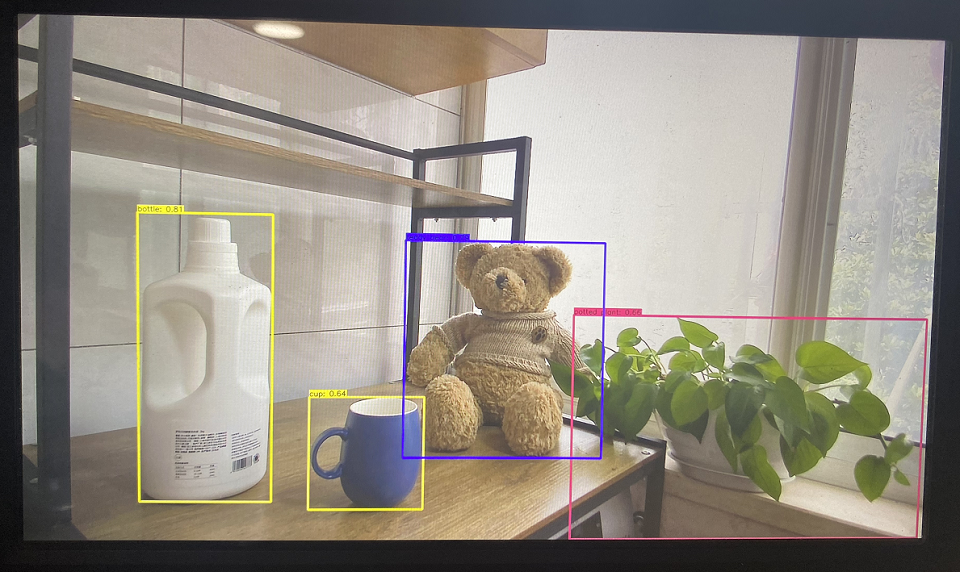
For detailed code implementation instructions, please refer to the Inference Based on USB Camera section.
Before connecting two USB cameras, you need to limit the bandwidth usage of uvcvideo by running rmmod uvcvideo; modprobe uvcvideo quirks=128
Multi-Camera Support
RDK series boards have only one USB controller. Multiple USB devices are expanded through a USB HUB. However, all peripherals essentially share the total bandwidth of this single USB port.
- For USB 2.0, all devices combined can only share a total bandwidth of 480 Mbps (approximately 500 Mbit/s);
- There is no scenario where "USB 2.0 peripherals share USB 3.0 total bandwidth."
Therefore, by default, when a USB 2.0 camera is connected, it tends to "greedily" request nearly all the bandwidth, making it impossible to connect a second camera.
The special UVC driver (uvcvideo) on the RDK can limit the camera's bandwidth usage within a certain range using the limitsize parameter, allowing two cameras to stream simultaneously.
rmmod uvcvideo.ko
modprobe uvcvideo limitsize=2
However, the core parameter for USB bandwidth budgeting is wMaxPacketSize, which is hardcoded in the endpoint descriptor of the device firmware.
If the firmware provides multiple Video Streaming configurations, wMaxPacketSize can be selected step by step from 1 x 192 bytes, 1 x 384 bytes, up to 3 x 1020 bytes.
When an MJPEG video stream is actually enabled, the device does not directly use the maximum value but selects an appropriate wMaxPacketSize based on resolution and frame rate.
Therefore, it is more flexible in bandwidth allocation, and when combined with uvcvideo limitsize=2, it allows two cameras to stream simultaneously. For example:
  Interface Descriptor:
    bLength                 9
    bDescriptorType         4
    bInterfaceNumber        1
    bAlternateSetting       1
    bNumEndpoints           1
    bInterfaceClass        14 Video
    bInterfaceSubClass      2 Video Streaming
    bInterfaceProtocol      0
    iInterface              0
    Endpoint Descriptor:
      bLength                 7
      bDescriptorType         5
      bEndpointAddress     0x81  EP 1 IN
      bmAttributes            5
        Transfer Type            Isochronous
        Synch Type               Asynchronous
        Usage Type               Data
      wMaxPacketSize     0x00c0  1x 192 bytes
      bInterval               1

 ......

  Interface Descriptor:
    bLength                 9
    bDescriptorType         4
    bInterfaceNumber        1
    bAlternateSetting      11
    bNumEndpoints           1
    bInterfaceClass        14 Video
    bInterfaceSubClass      2 Video Streaming
    bInterfaceProtocol      0
    iInterface              0
    Endpoint Descriptor:
      bLength                 7
      bDescriptorType         5
      bEndpointAddress     0x81  EP 1 IN
      bmAttributes            5
        Transfer Type            Isochronous
        Synch Type               Asynchronous
        Usage Type               Data
      wMaxPacketSize     0x13fc  3x 1020 bytes
      bInterval
If the firmware provides only one set of Video Streaming configurations, wMaxPacketSize = 3 x 1024 bytes.
This means it always requests the maximum bandwidth, and no matter how the driver limits it, two cameras cannot stream simultaneously and stably.
  Interface Descriptor:
    bLength                 9
    bDescriptorType         4
    bInterfaceNumber        1
    bAlternateSetting       1
    bNumEndpoints           1
    bInterfaceClass        14 Video
    bInterfaceSubClass      2 Video Streaming
    bInterfaceProtocol      0
    iInterface              0
    Endpoint Descriptor:
      bLength                 7
      bDescriptorType         5
      bEndpointAddress     0x88  EP 8 IN
      bmAttributes            5
        Transfer Type            Isochronous
        Synch Type               Asynchronous
        Usage Type               Data
      wMaxPacketSize     0x1400  3x 1024 bytes
      bInterval
How to query wMaxPacketSize
lsusb -v -d <vid>:<pid>