2.1 Network and Bluetooth Configuration
This section mainly introduces the methods for modifying the wired and wireless network configurations of the development board.
Wired Network: RDK X5 (>= 3.3.0) RDK X3 (>= 3.0.2)
Video: https://www.youtube.com/watch?v=omaAU6sab2A&list=PLSxjn4YS2IuFUWcLGj2_uuCfLYnNYw6Ld&index=8
The development board's wired network uses a static IP configuration by default, with an initial IP address of 192.168.127.10. Users can switch between static and DHCP modes using the following methods.
[Shell] Modifying Static IP Configuration
The static network configuration of the development board is saved in the /etc/NetworkManager/system-connections/netplan-eth0.nmconnection file. By modifying the address1 field, you can change the static IP configuration. The route-metric field is for network priority configuration; setting it to 700 gives the wired network a lower priority, so when both wired and wireless networks are enabled, the wireless network will be used first.
sudo vim /etc/NetworkManager/system-connections/netplan-eth0.nmconnection
[connection]
id=netplan-eth0
uuid=f6f8b5a7-9e23-49b2-a792-dc589b3d3e88
type=ethernet
interface-name=eth0
timestamp=1754294545

[ethernet]
wake-on-lan=0

[ipv4]
address1=192.168.127.10/24,192.168.127.1
dns=8.8.8.8;8.8.4.4;
method=manual
route-metric=700

[ipv6]
addr-gen-mode=eui64
method=ignore

[proxy]
After making the changes, run the sudo restart_network command to apply the configuration.
[Shell] Modifying DHCP Configuration
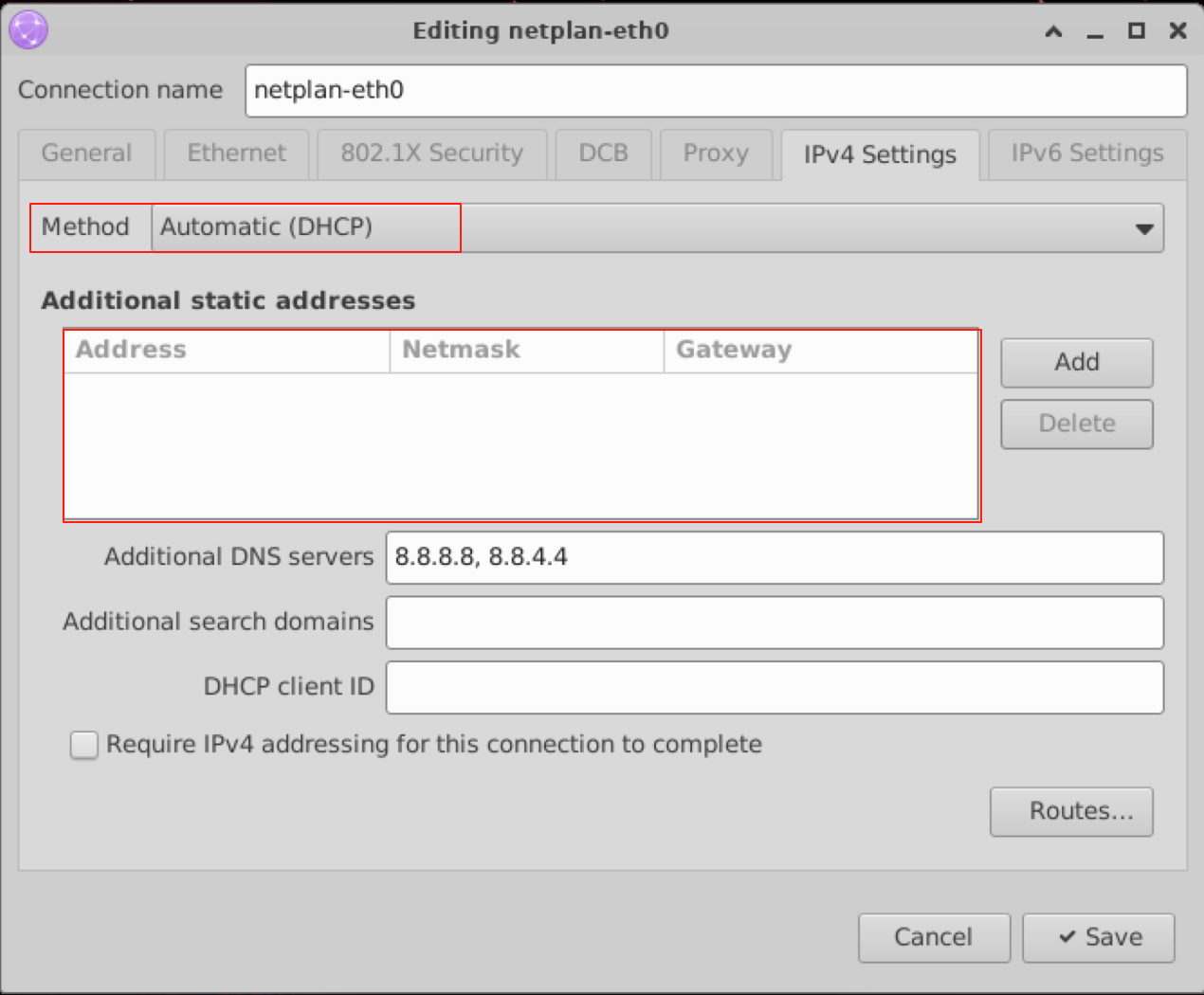
Modify the [ipv4] field, keeping only method=auto and route-metric=700.
[ipv4]
method=auto
route-metric=700
After making the changes, run the sudo restart_network command to apply the configuration.
[Shell] Modifying MAC Address Configuration
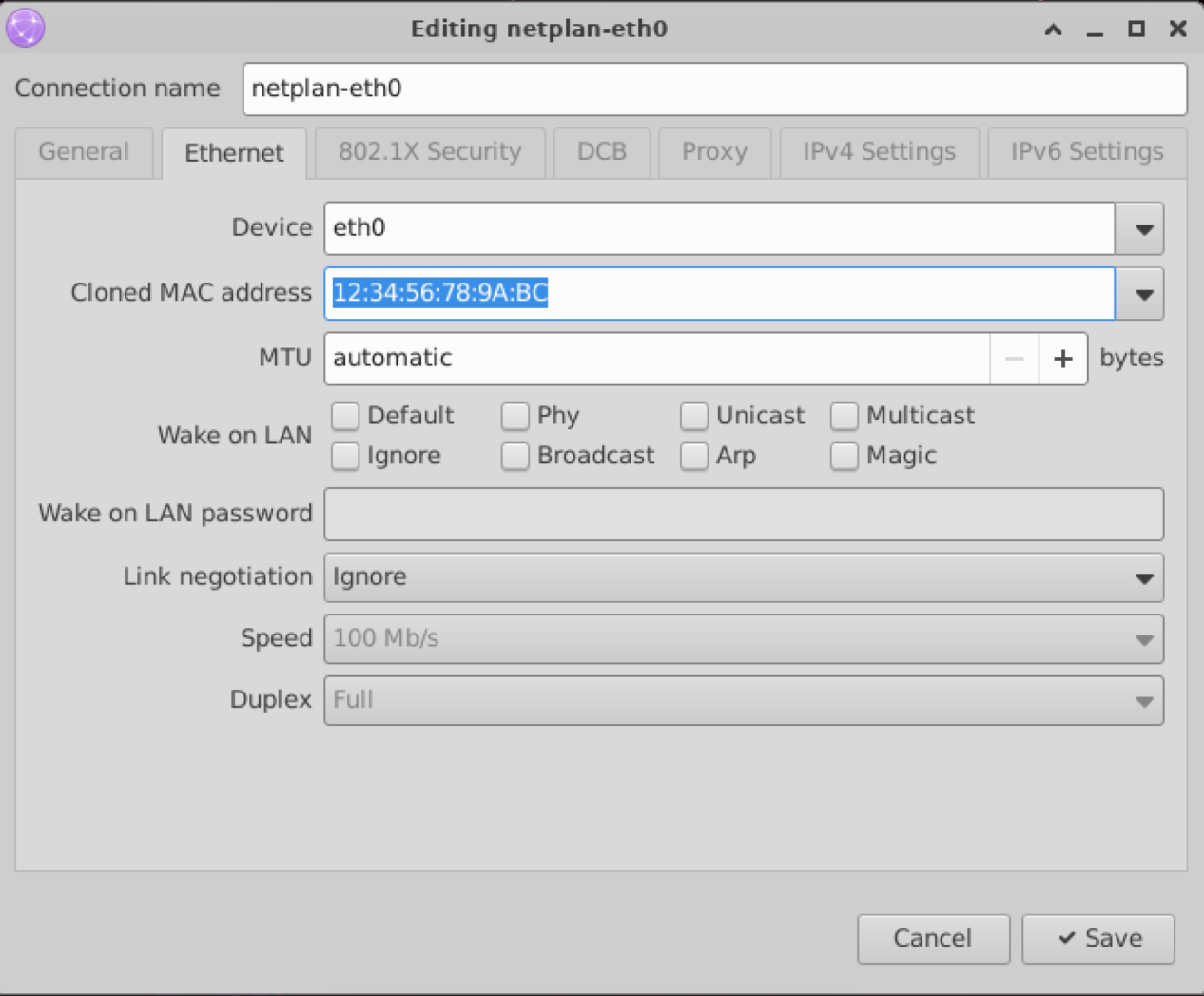
Modify the [ethernet] field, adding cloned-mac-address=12:34:56:78:9A:BA.
[ethernet]
cloned-mac-address=12:34:56:78:9A:BA
wake-on-lan=0
After making the changes, reboot to apply the configuration.
[Desktop] Modifying Static IP Configuration
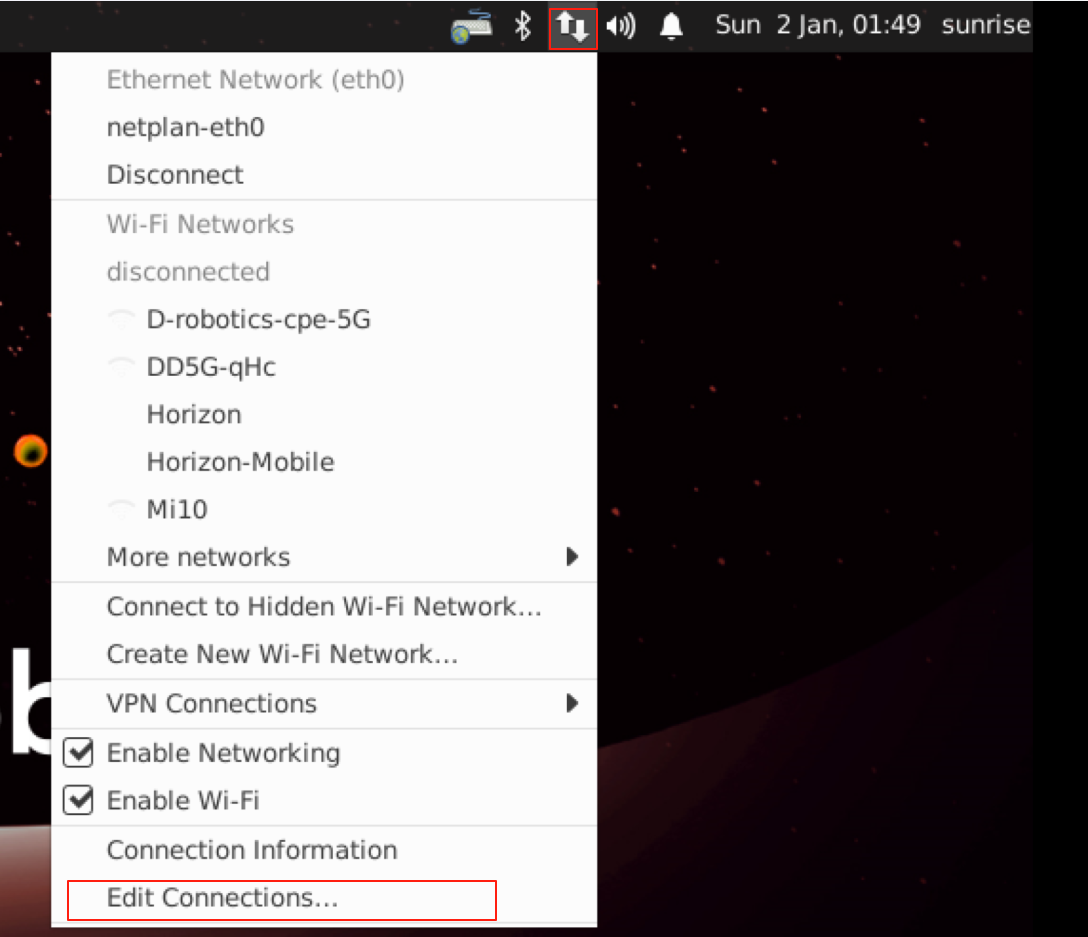
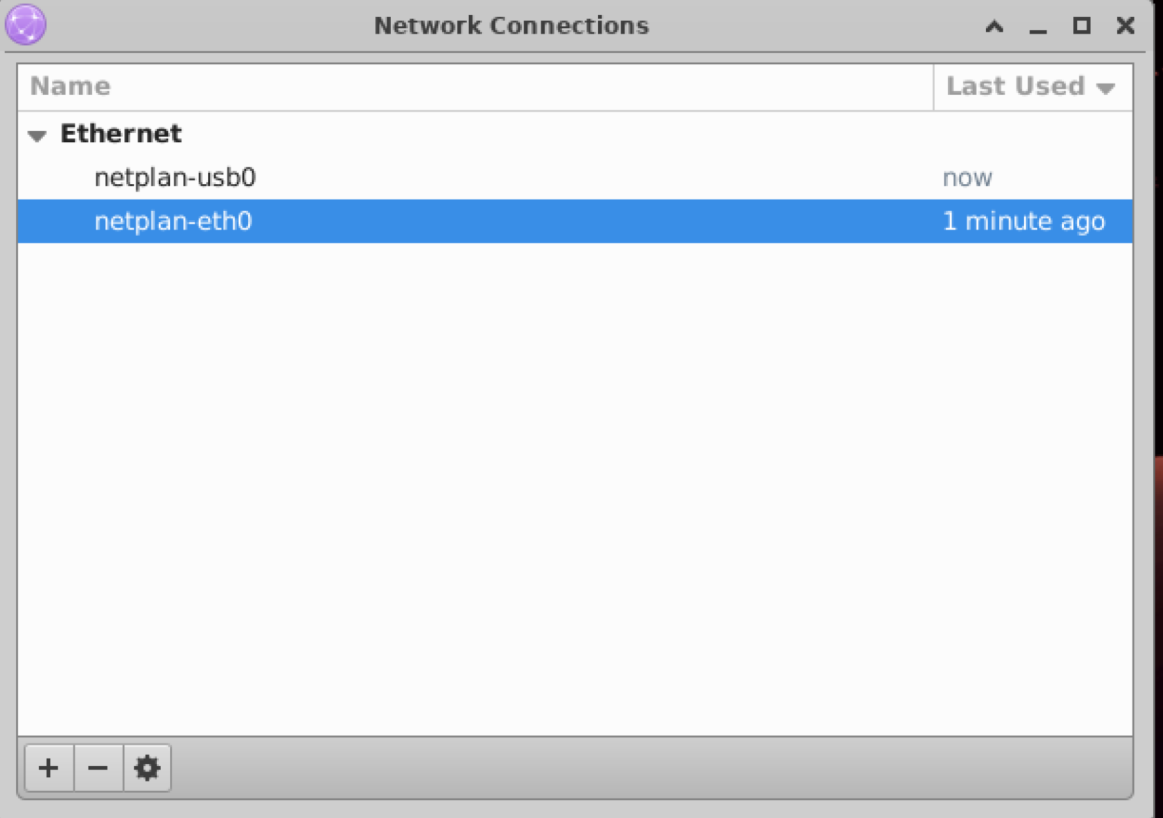
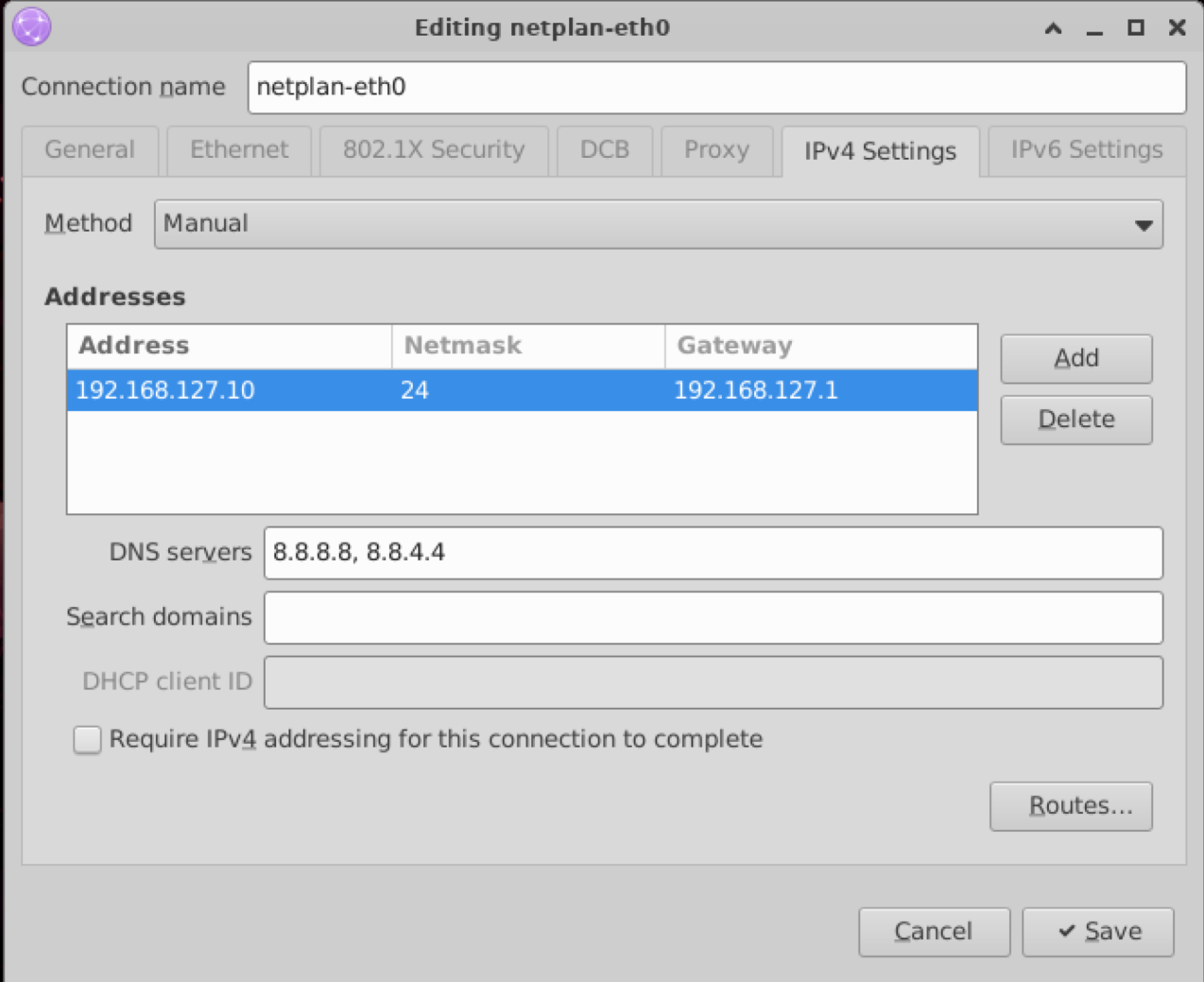
[Desktop] Modifying DHCP Configuration
[Desktop] Modifying MAC Address Configuration
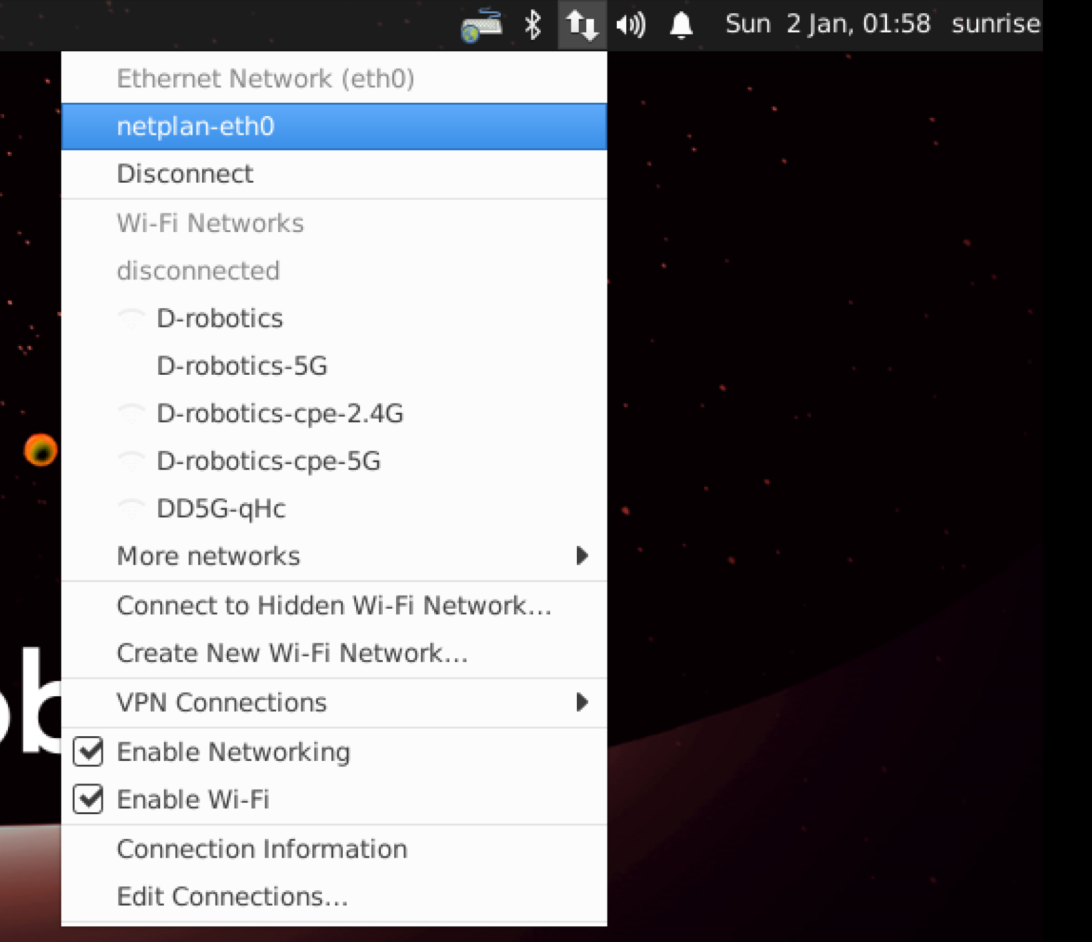
[Desktop] Applying the Configuration
Select netplan-eth0 to apply the configuration.
Wired Network: RDK X5 (< 3.3.0) RDK X3 (< 3.0.2)
Video: https://www.bilibili.com/video/BV1rm4y1E73q/?p=11
The development board's wired network uses a static IP configuration by default, with an initial IP address of 192.168.127.10. Users can switch between static and DHCP modes using the following methods.
Modifying Static IP Configuration
The static network configuration of the development board is saved in the /etc/network/interfaces file. By modifying fields such as address, netmask, and gateway, you can change the static IP configuration. The metric field is for network priority configuration; setting it to 700 gives the wired network a lower priority, so when both wired and wireless networks are enabled, the wireless network will be used first. For example:
sudo vim /etc/network/interfaces
# interfaces(5) file used by ifup(8) and ifdown(8)
# Include files from /etc/network/interfaces.d:
source-directory /etc/network/interfaces.d
auto eth0
iface eth0 inet static
    pre-up /etc/set_mac_address.sh
    address 192.168.127.10
    netmask 255.255.255.0
    gateway 192.168.127.1
    metric 700
After making the changes, run the sudo restart_network command to apply the configuration.
Modifying DHCP Configuration
DHCP (Dynamic Host Configuration Protocol) is commonly used in local area network environments. Its main function is to centrally manage and assign IP addresses, allowing hosts on the network to dynamically obtain IP addresses, gateway addresses, DNS server addresses, and other information, thereby improving address utilization.
The DHCP network configuration of the development board is saved in the /etc/network/interfaces file. By modifying the eth0-related configuration, you can switch to DHCP mode. For example:
sudo vim /etc/network/interfaces
source-directory /etc/network/interfaces.d
auto lo
iface lo inet loopback
auto eth0
iface eth0 inet dhcp
    metric 700
After making the changes, run the sudo restart_network command to apply the configuration.
Modifying MAC Address Configuration
To modify the default MAC address of the development board, you can add pre-up configuration information in the /etc/network/interfaces file to specify the desired MAC address. For example:
sudo vim /etc/network/interfaces
# interfaces(5) file used by ifup(8) and ifdown(8)
# Include files from /etc/network/interfaces.d:
source-directory /etc/network/interfaces.d
auto eth0
iface eth0 inet static
    pre-up /etc/set_mac_address.sh
    address 192.168.127.10
    netmask 255.255.255.0
    gateway 192.168.127.1
    metric 700
    pre-up ifconfig eth0 hw ether 00:11:22:9f:51:27
After making the changes, reboot to apply the configuration.
Wireless Network
Video: https://www.bilibili.com/video/BV1rm4y1E73q/?p=12
The development board integrates a 2.4GHz wireless WiFi module, supporting both Soft AP and Station modes. It runs in Station mode by default. The following sections describe how to use both modes.
Station Mode
In Station mode, the development board acts as a client, connecting to a router's wireless hotspot for network access.
-
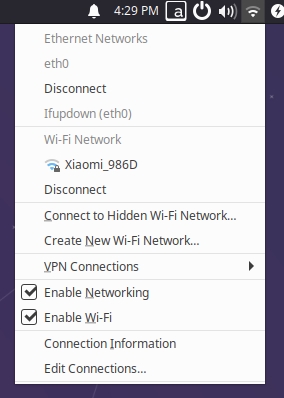
For users of the Ubuntu Desktop version, click the Wi-Fi icon in the top-right corner of the desktop, select the desired hotspot, and enter the password to complete the network configuration, as shown below:
-
For users of the Ubuntu Server version, you can configure the wireless network via the command line. The steps are as follows:
-
Use the
sudo nmcli device wifi rescancommand to scan for hotspots. If the following message appears, the scan is too frequent, and you should try again later.root@ubuntu:~# sudo nmcli device wifi rescan
Error: Scanning not allowed immediately following previous scan. -
Use the
sudo nmcli device wifi listcommand to list the detected hotspots. -
Use the
sudo wifi_connect "SSID" "PASSWD"command to connect to a hotspot. The following message indicates a successful connection.root@ubuntu:~# sudo wifi_connect "WiFi-Test" "12345678"
Device 'wlan0' successfully activated with 'd7468833-4195-45aa-aa33-3d43da86e1a7'.tipIf the following message appears after attempting to connect to a hotspot, it means the hotspot was not found. You can run
sudo nmcli device wifi rescanto rescan and try connecting again.root@ubuntu:~# sudo wifi_connect "WiFi-Test" "12345678"
Error: No network with SSID 'WiFi-Test' found.
Soft AP Mode
The development board's wireless network runs in Station mode by default. To use Soft AP mode, follow the steps below.
-
Install
hostapdandisc-dhcp-server.sudo apt update
sudo apt install hostapd
sudo apt install isc-dhcp-server -
Run the
sudo vim /etc/hostapd.confcommand to configurehostapd.conf, paying attention to the following fields:interface=wlan0 # Network card acting as the AP hotspot
ssid=Sunrise # WiFi name
wpa=2 # 0 for WPA, 2 for WPA2, typically 2
wpa_key_mgmt=WPA-PSK # Encryption algorithm, typically WPA-PSK
wpa_passphrase=12345678 # Password
wpa_pairwise=CCMP # Encryption protocol, typically CCMP- For a hotspot without a password, add the following content to the
hostapd.conffile:
interface=wlan0
driver=nl80211
ctrl_interface=/var/run/hostapd
ssid=Sunrise
channel=6
ieee80211n=1
hw_mode=g
ignore_broadcast_ssid=0- For a hotspot with a password, add the following content to the
hostapd.conffile:
interface=wlan0
driver=nl80211
ctrl_interface=/var/run/hostapd
ssid=Sunrise
channel=6
ieee80211n=1
hw_mode=g
ignore_broadcast_ssid=0
wpa=2
wpa_key_mgmt=WPA-PSK
wpa_pairwise=CCMP
wpa_passphrase=12345678- For RDK X5, you can configure a 5GHz hotspot by modifying the
hw_modeandchannelfields in thehostapd.conffile:
channel=36
hw_mode=a - For a hotspot without a password, add the following content to the
-
Configure the
isc-dhcp-serverfile as follows:- Run
sudo vim /etc/default/isc-dhcp-serverto modify theisc-dhcp-serverfile, adding the defined network interface:
INTERFACESv4="wlan0"- Run
sudo vim /etc/dhcp/dhcpd.confto modify thedhcpd.conffile, uncommenting the following field:
authoritative;- Then add the following configuration at the end of the
/etc/dhcp/dhcpd.conffile:
  subnet 10.5.5.0 netmask 255.255.255.0 { # Subnet and netmask
  range 10.5.5.100 10.5.5.254; # Usable IP range
  option subnet-mask 255.255.255.0; # Netmask
  option routers 10.5.5.1; # Default gateway
  option broadcast-address 10.5.5.31; # Broadcast address
  default-lease-time 600; # Default lease time, in seconds
  max-lease-time 7200; # Maximum lease time, in seconds
} - Run
-
Stop the
wpa_supplicantservice and restartwlan0.systemctl mask wpa_supplicant
systemctl stop wpa_supplicant
ip addr flush dev wlan0
sleep 0.5
ifconfig wlan0 down
sleep 1
ifconfig wlan0 up -
Start the
hostapdservice as follows:- Run the
sudo hostapd -B /etc/hostapd.confcommand.
 root@ubuntu:~# sudo hostapd -B /etc/hostapd.conf

 Configuration file: /etc/hostapd.conf
 Using interface wlan0 with hwaddr 08:e9:f6:af:18:26 and ssid "sunrise"
 wlan0: interface state UNINITIALIZED->ENABLED
wlan0: AP-ENABLED- Use the
ifconfigcommand to configure the IP and subnet of the wireless interfacewlan0, ensuring consistency with the configuration in step 3.
sudo ifconfig wlan0 10.5.5.1 netmask 255.255.255.0- Finally, start the DHCP server. When connected to the hotspot, the client will be assigned an IP address ranging from
10.5.5.100to10.5.5.255.
sudo ifconfig wlan0 10.5.5.1 netmask 255.255.255.0
sudo systemctl start isc-dhcp-server
sudo systemctl enable isc-dhcp-server - Run the
-
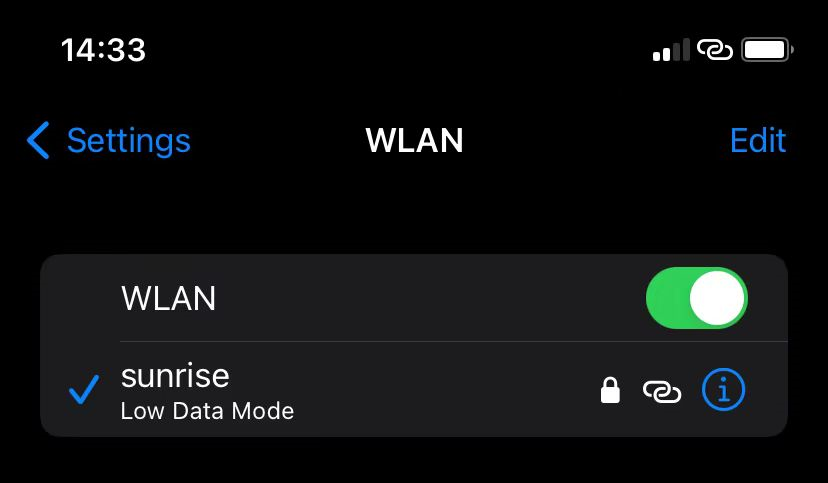
Connect to the development board's hotspot, e.g.,
sunrise.
-
To switch back to Station mode, follow the steps below:
[RDK X5]
# Stop hostapd
killall -9 hostapd

# Clear wlan0 address
ip addr flush dev wlan0
sleep 0.5
ifconfig wlan0 down
sleep 1
ifconfig wlan0 up

# Restart wpa_supplicant
systemctl unmask wpa_supplicant
systemctl restart wpa_supplicant

# Reload wifi driver
rmmod aic8800_fdrv
modprobe aic8800_fdrv

# Connect to hotspot. Refer to the previous section "Wireless Network" for details.
wifi_connect "WiFi-Test" "12345678"
[Other]
# Stop hostapd
killall -9 hostapd

# Clear wlan0 address
ip addr flush dev wlan0
sleep 0.5
ifconfig wlan0 down
sleep 1
ifconfig wlan0 up

# Restart wpa_supplicant
systemctl unmask wpa_supplicant
systemctl restart wpa_supplicant

# Connect to hotspot. Refer to the previous section "Wireless Network" for details.
wifi_connect "WiFi-Test" "12345678"
Soft AP Mode (NetworkManager): RDK X5 (>= 3.3.0) RDK X3 (>= 3.0.2)
Newer system versions can also use NetworkManager to create a WiFi hotspot.
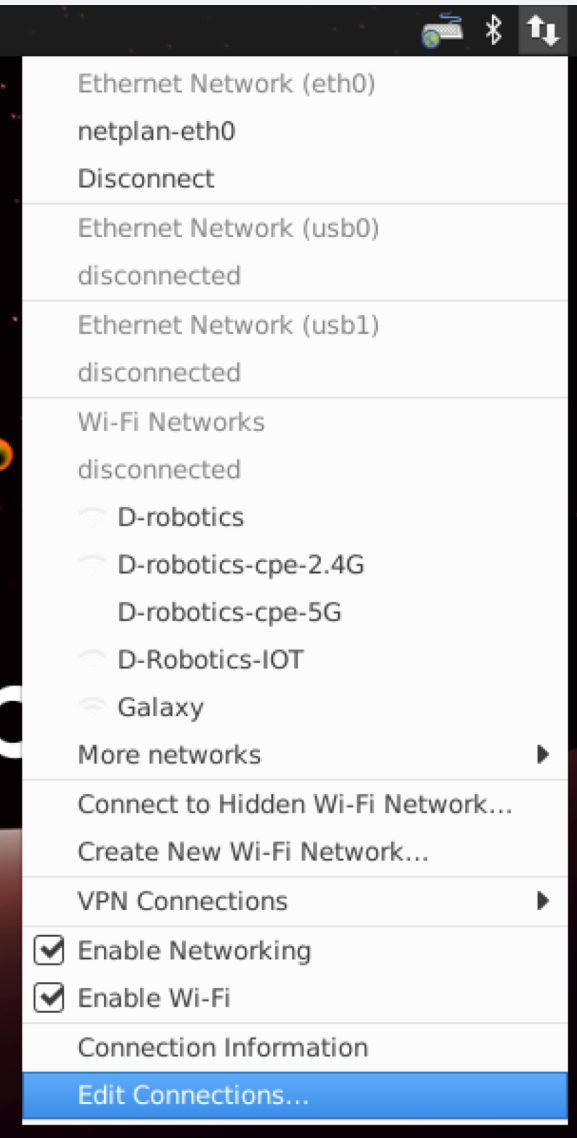
Click the wireless network icon in the top-right corner of the desktop and select Edit Connections...
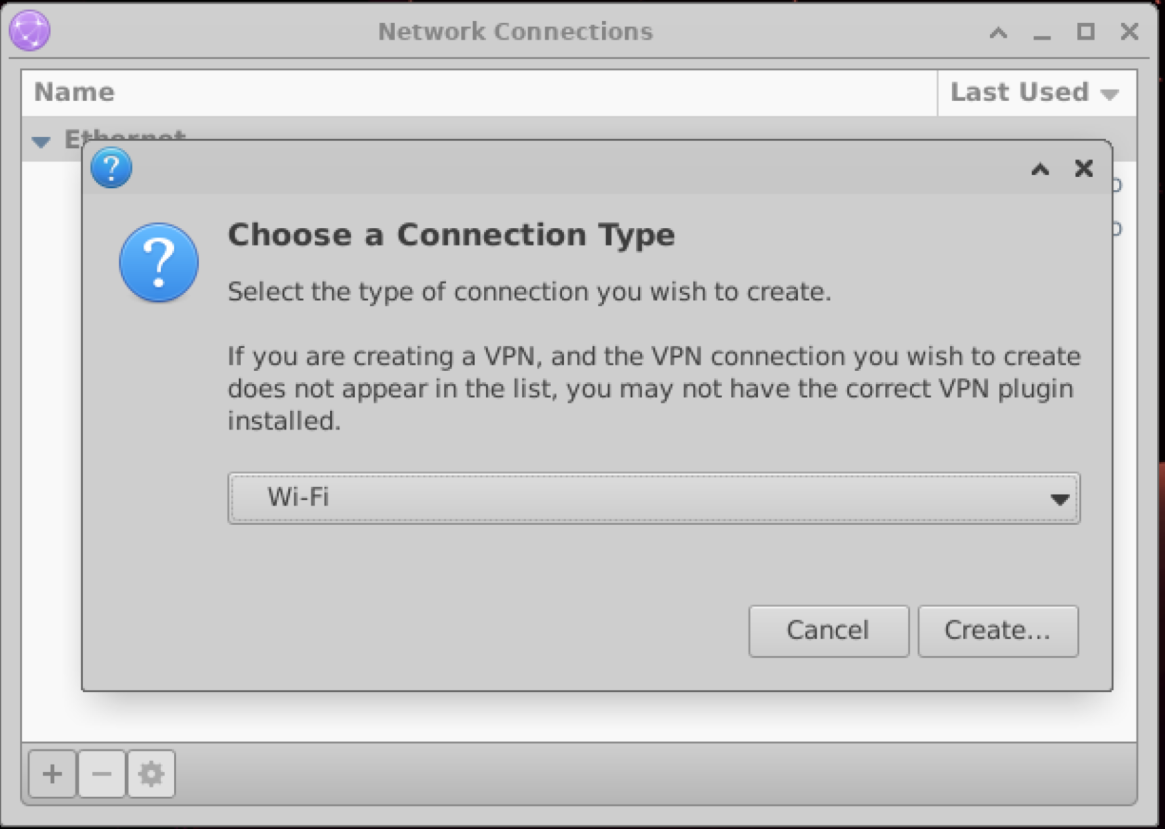
Click the + button in the bottom-left corner, and select Wi-Fi as the Connection Type.
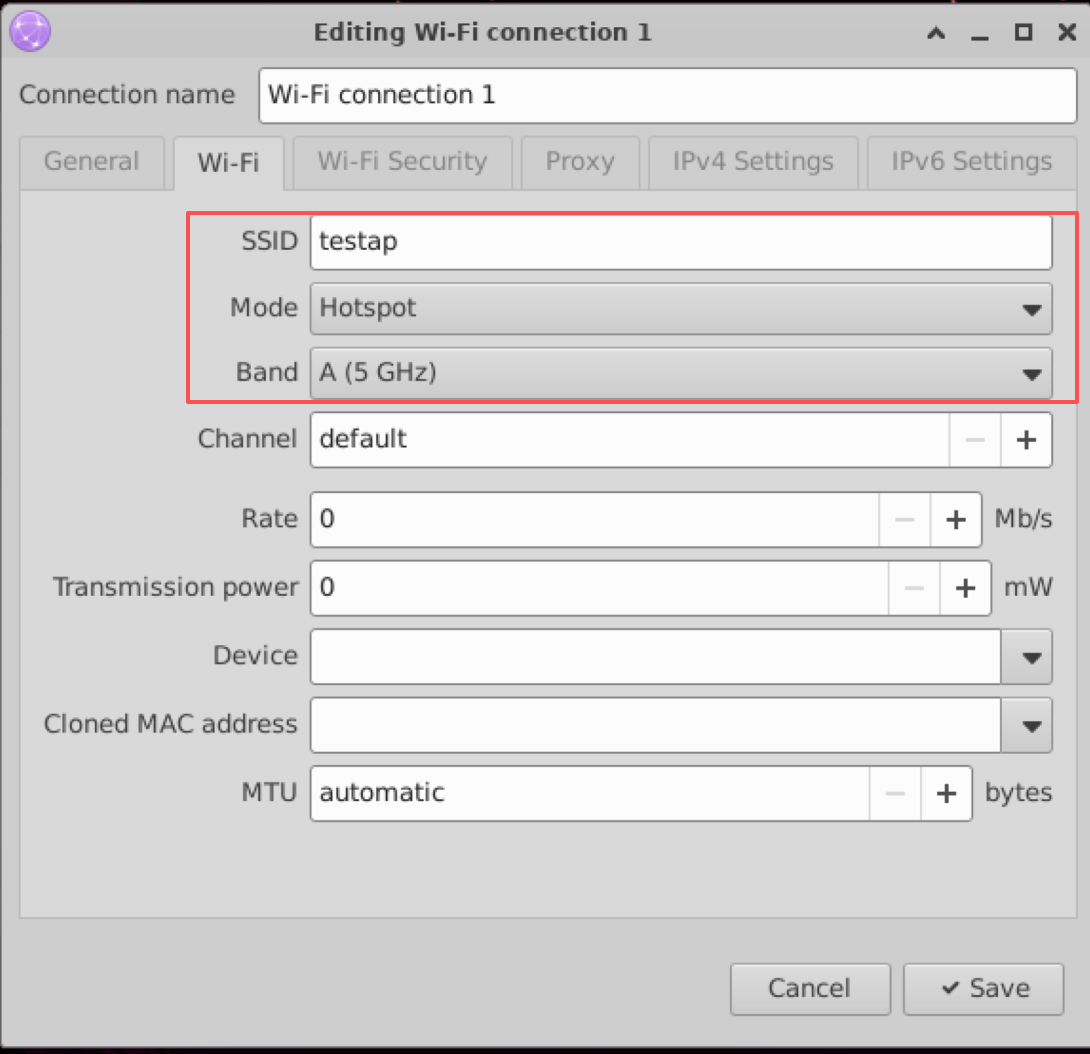
Under the Wi-Fi tab, fill in the SSID, Mode, and Band.
Enter your desired hotspot name in the SSID field.
Select Hotspot as the Mode.
For Band, you can choose Automatic, A (5 GHz), or B/G (2.4 GHz).
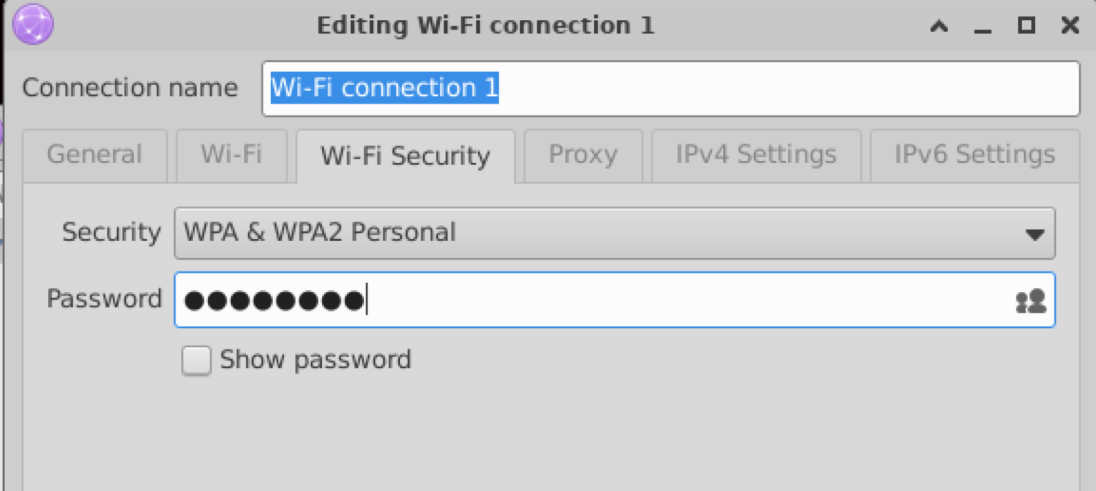
Under the Wi-Fi Security tab, select the encryption method and enter the password.
Reboot the board or run restart_network to apply the configuration.
DNS Service
Video: https://www.bilibili.com/video/BV1rm4y1E73q/?p=13
DNS (Domain Name Server) is a server that translates domain names into their corresponding IP addresses.
The DNS configuration of the development board is managed through the /etc/systemd/resolved.conf file. Users can modify this file to configure DNS settings. The steps are as follows:
-
Modify the
resolved.conffile to add DNS server addresses, for example:DNS=8.8.8.8 114.114.114.114 -
Apply the DNS configuration using the following commands:
sudo systemctl restart systemd-resolved
sudo systemctl enable systemd-resolved
sudo mv /etc/resolv.conf  /etc/resolv.conf.bak
sudo ln -s /run/systemd/resolve/resolv.conf /etc/
System Update
For system security and stability, it is recommended that users update the system using the apt command after installation.
The /etc/apt/source.list file contains the list of software sources for the apt command. Before installing software, you need to update the package list using the apt command.
First, open a terminal and enter the following command:
sudo apt update
Next, upgrade all installed packages to their latest versions using the following command:
sudo apt full-upgrade
It is recommended to use the full-upgrade option instead of upgrade, as it will also update dependent packages when related dependencies change.
When running the sudo apt full-upgrade command, the system will prompt you about the data download size and disk usage. However, apt does not check if there is sufficient disk space. It is recommended that users manually check using the df -h command. Additionally, the deb files downloaded during the upgrade are saved in the /var/cache/apt/archives directory. Users can delete these cache files using the sudo apt clean command to free up disk space.
After executing the apt full-upgrade command, drivers, kernel files, and some system software may be reinstalled. It is recommended that users manually reboot the device for the updates to take effect, using the following command:
sudo reboot
Bluetooth Configuration
Starting from version 3.0.0, Bluetooth starts by default with the system, and no manual re-initialization is required. This behavior is consistent on both the RDK X3 and RDK X5 platforms.
Initialization
If the Bluetooth function on the development board is not enabled by default and the device is not visible with hciconfig, you can run the /usr/bin/startbt.sh script to initialize it. This script performs the following tasks:
- Initializes Bluetooth
- Runs
hciconfig hci0 upto bring the Bluetooth link up - Runs
hciconfig hci0 piscanto perform Bluetooth scanning
Video: https://www.bilibili.com/video/BV1rm4y1E73q/?p=9
The log after a successful script execution is as follows:
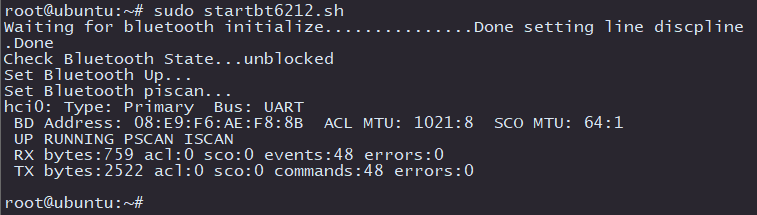
Additionally, users can check if the Bluetooth process is running normally using the following command:
ps ax | grep "/usr/bin/dbus-daemon\|/usr/lib/bluetooth/bluetoothd"
/usr/bin/dbus-daemon

/usr/lib/bluetooth/bluetoothd
Communication Interfaces
To fully leverage the expansion capabilities of the development board, the current hardware design integrates a variety of interfaces and peripheral resources.
Due to interface layout and hardware resource allocation constraints, the development board does not replicate all communication interfaces of the Bluetooth module.
Currently, only the BT_RX and BT_TX two-wire mode is provided, which can meet basic functions such as AT command interaction and data transmission without real-time requirements.
For Bluetooth modules based on the UART interface, the different interface connection methods and their corresponding functions are as follows:
- Basic Communication Mode (UART Only)
-
- Interface Pins:
BT_RX,BT_TX
- Interface Pins:
-
- Functional Features: Asynchronous serial data communication over UART (e.g., AT command interaction, low-rate data transmission). No flow control mechanism. Risk of data packet loss and buffer overflow during baud rate overload or continuous high-volume data transmission.
- Enhanced Transmission Mode (with Hardware Flow Control)
-
- Interface Pins:
BT_RX,BT_TX,BT_CTS,BT_RTS
- Interface Pins:
-
- Functional Features: Effectively avoids the risk of data packet loss and buffer overflow. Supports A2DP high-fidelity unidirectional audio streaming.
- Voice Communication Mode (PCM Synchronous Interface)
-
- Interface Pins:
PCM_SYNC,PCM_DIN,PCM_CLK,PCM_DOUT
- Interface Pins:
-
- Functional Features: Supports real-time bidirectional audio transmission over SCO links, e.g., HFP/HSP.
USB Bluetooth
For advanced use of Bluetooth features, such as high-speed, stable communication in SPP (Bluetooth Virtual Serial Port) mode, bandwidth quality assurance in PAN (Bluetooth Virtual Network Adapter) mode, or avoiding audio interruptions in A2DP (High-Fidelity Unidirectional Audio Streaming) mode, it is recommended to use a USB Bluetooth module.
The development board integrates drivers for common Bluetooth modules such as USB2.0-BT and CSR8510 A10, which directly support most firmware-free USB Bluetooth modules.



For Realtek series Bluetooth modules, additional firmware support is required. Obtain the firmware adapted for the Linux platform from the module manufacturer and place it in the designated directory before normal use.
Network Configuration and Connection
Run sudo bluetoothctl to enter the interactive Bluetooth configuration interface. Device information similar to the image below indicates that the Bluetooth device has been recognized. Use show to view Bluetooth information, paying attention to the powered and discoverable states.
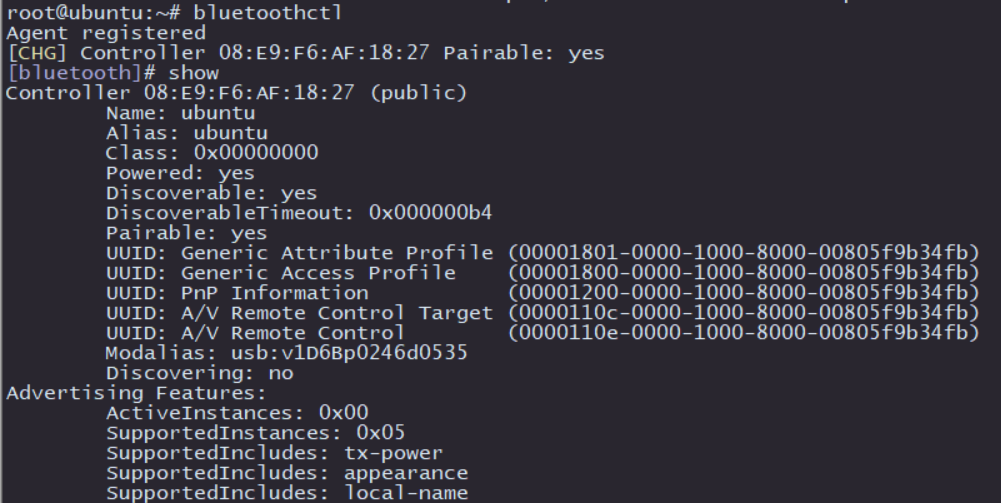
Run power on to enable Bluetooth, as shown in the image below:

To make the Bluetooth device discoverable by nearby devices, run discoverable on to enable Bluetooth and turn on the discoverable property, as shown below:

Now, you can use a mobile phone or computer to scan for the Bluetooth device with the name ubuntu, as shown in the image below:
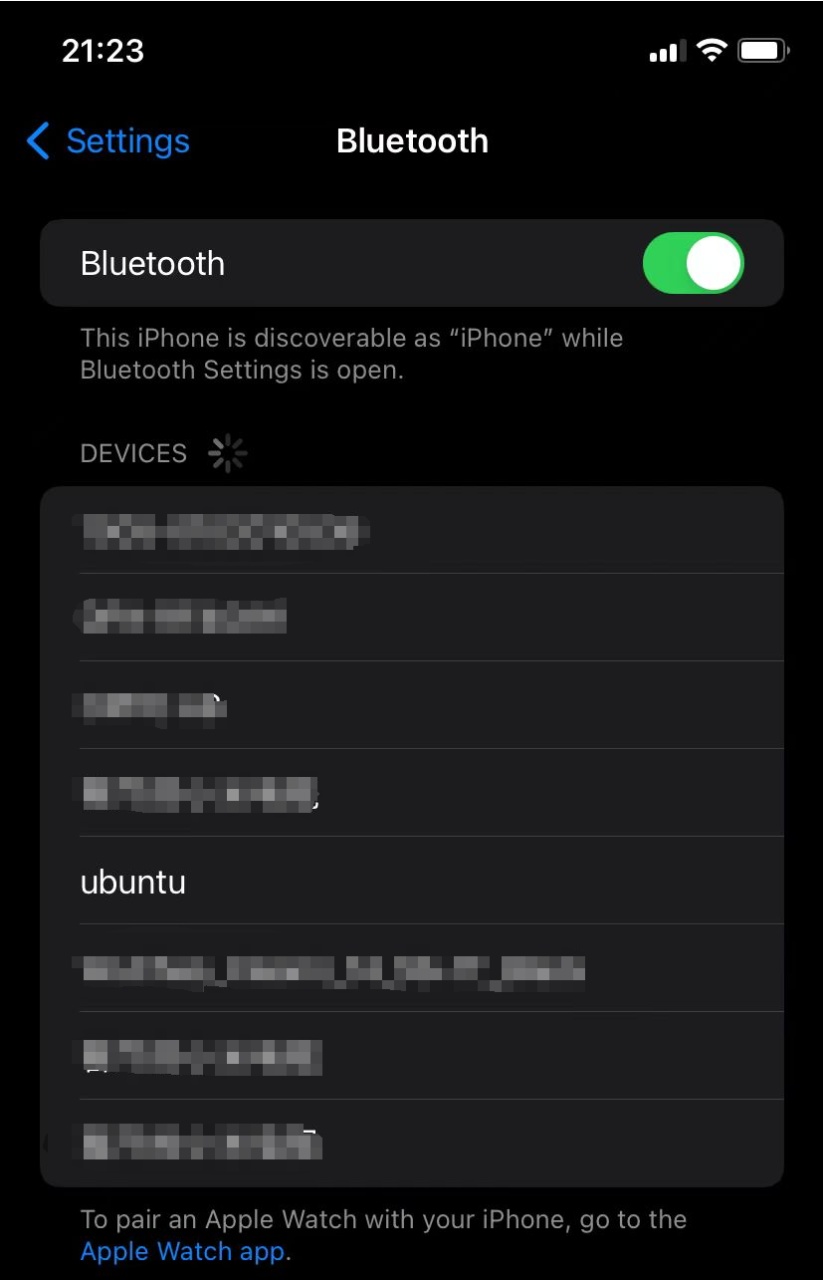
Next, test the active scanning function of Bluetooth. In the interactive interface of bluetoothctl, enter scan on to enable active scanning. It will periodically print nearby devices. You can see that my mobile phone device has been discovered. Enter scan off to disable the scanning function and summarize the scanned Bluetooth devices.
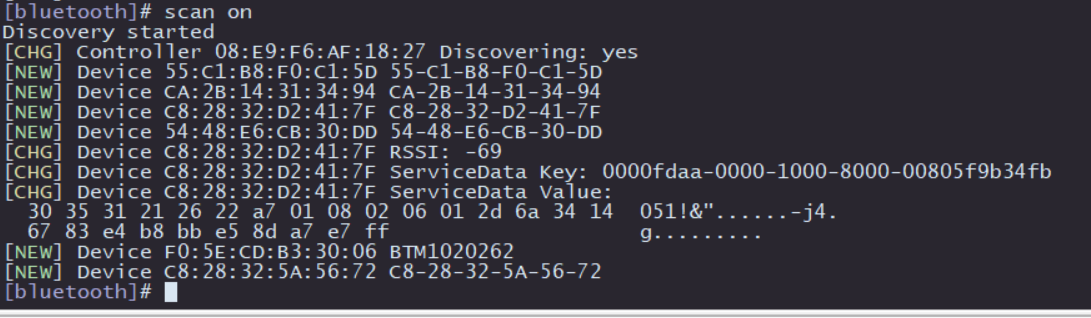
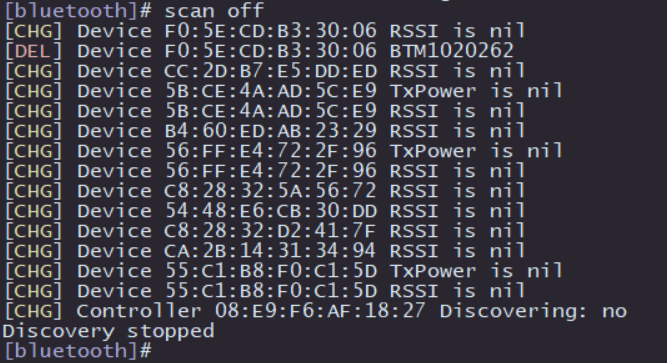
Then comes the pairing with other Bluetooth devices:
-
Pairing command:
pair [targetMAC], after entering this command, follow the prompts to enteryes, and the remote Bluetooth device will select thePairoption to complete the pairing. -
After successful pairing, you can use
trust [targetMAC]to automatically connect next time.
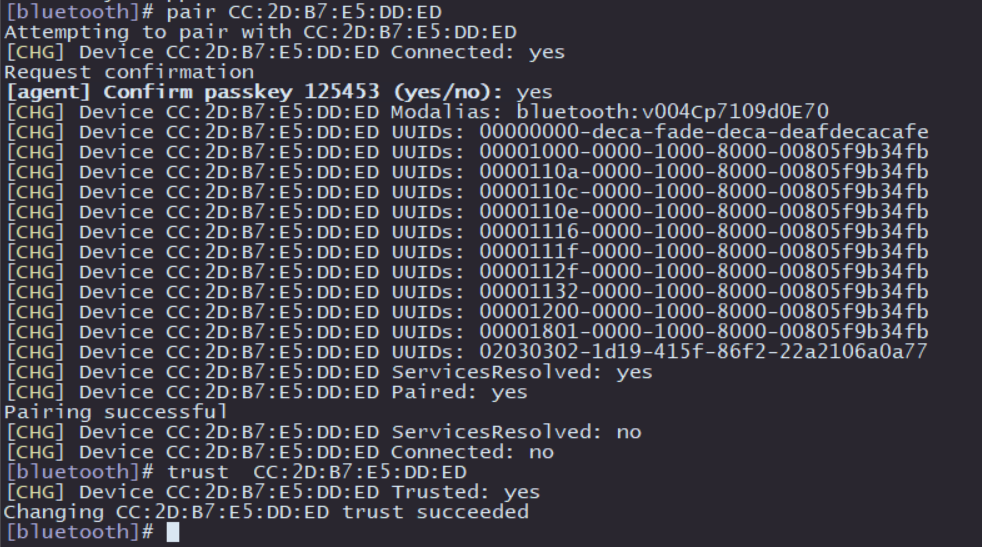
After the above operations, the basic functions of Bluetooth scanning and pairing are completed. For more functions, please refer to the official help documentation of BlueZ.